

Table of Contents
Good outdoor lighting starts with what each area is for: welcoming people at the front door, guiding feet along paths and steps, setting a mood on the patio and bringing out the best of the garden. Then three technical points: an IP rating matched to the exposure, a warm white light that dazzles no one, and wiring done by a registered electrician.
Good outdoor lighting does not try to make the garden as bright as day. It puts light where you walk, where you sit and where you want the eye to rest, and leaves the rest in a soft darkness that gives an evening outside all its charm. In the UK it also has to cope with a climate that tests every fitting: rain driven sideways by the wind, damp air for months on end, salt on the coast and long winter nights when the lights are on from teatime. This guide walks you round the house zone by zone, from the front door to the end of the garden. It explains which type of light suits each place, how to read an IP rating, how to decide between mains, solar and low voltage, and which rules apply in the UK when a cable has to be run outside. If you already know what you want, our range of outdoor wall lights is the place to start.
Where to start with outdoor lighting
Walk round the house at dusk with a notebook. Write down the places where you need to see (the lock on the front door, the steps, the gate, the boot of the car), the places where you like to sit (the patio, the bench under the tree, the corner of the decking that gets the evening sun) and the things you would like to look at from the kitchen or the living room (a fine tree, a border, an old stone wall). You end up with three families of light, and each one calls for different fittings.
- Safety lighting lights the way in and anything you could trip over. It has to come on quickly without anyone fumbling for a switch in the rain, and it has to work every single night of the year.
- Guide lighting marks out a path, a driveway or a flight of steps. It lights the ground, not people’s eyes, and it needs very little power.
- Ambient lighting dresses the patio and the garden. It is softer, often dimmable, and it is what makes you want to stay outside after dinner on a mild summer evening.
A common mistake is to buy one powerful floodlight and expect it to do all three jobs. It lights everything flatly, it dazzles you as you walk towards it, and it spills into the neighbours’ windows. Several small, well-aimed lights almost always give a better result for the same budget, and they use less electricity because each one can be switched on only when it is needed.
A few rules of thumb
Lighting designers work to a handful of simple principles that you can apply at home without any calculation. Light the task, not the space: the keyhole, the step, the table, the tree. Hide the source, show the effect: the eye should see a lit wall, a pool of light on the path or the glow in a canopy, not a bright bulb. Work in layers: a low layer for the ground, a middle layer at wall height, and, where it makes sense, a high layer in a tree or under a pergola. Keep it low and warm: a light close to the ground and a warm white look more natural at night than a high, cold one.
Before anything is fixed or wired, test your ideas. Wait for a dry evening, take a strong torch or a couple of cordless lamps and try them in the places you have in mind: at the foot of the tree, beside the steps, on the wall by the door. Look from the house as well as from the garden. Ten minutes of trial in the dark saves many a fitting in the wrong place, and it gives your electrician a clear plan to price.
The table below sums up the most common choices. Use it as a plan before you look at individual fittings.
| Area | Main role | Suitable fittings | Best way to switch |
|---|---|---|---|
| Front door | Safety, welcome | Wall light, ceiling light in the porch | PIR sensor or indoor switch |
| Path, steps | Guide | Bollards, post lights, recessed ground lights | Dusk-to-dawn sensor or PIR |
| Patio, decking, balcony | Mood, dining | Wall lights, outdoor pendant, festoon lights | Switch, dimmer |
| Front of the house | Showing off the building | Up and down wall light, grazing light | Timer |
| Garden, trees | Depth, decoration | Spike spotlights, low lights, solar | Timer, remote or app |
| Gate, driveway, garage | Safety | Wall light, bulkhead light | PIR sensor |
Before you buy anything, also check where the power will come from. An outside wall that already has a light point is easy to work with. The far end of the garden, forty metres from the house, is a different project altogether, and that often decides whether a spot gets a mains fitting or a solar one.
Outdoor lighting ideas for each part of the house
Once the plan is drawn, each area calls for a type of fitting. The right choice depends as much on the direction of the light as on the style of the fitting.
The front door and the porch
A wall light is still the simplest answer for a front door: it fixes to the wall beside the door and lights both the step and the face of whoever rings the bell. Mount it a little above eye level so that the light source is not in anyone’s line of sight. Beside a wide door or a garage, a pair of wall lights, one on each side, gives a more even light than a single strong point, and the doorway looks more balanced in daylight too.
Up and down wall lights, which send light both upwards and downwards, draw a crisp pattern on the wall while lighting the ground. That is the idea behind our modern square wall light with adjustable brightness, rated IP54, which works as well either side of a front door as it does on a patio wall. The adjustable brightness is useful at the door: bright enough to find your keys, low enough not to glare at the house across the road.
Many British houses have an enclosed porch, a small glazed room between the front door and the hall. It is not outdoors, but it is cold and often damp, and the door opens straight onto the weather. A ceiling light rated IP44, protected against splashing water, is a sensible choice there: our glass and aluminium globe ceiling light is rated IP44 and gives a soft, even glow through its glass. Under an open canopy, choose a fitting that is sold for outdoor use, or an outdoor pendant light if the canopy is deep enough.
The driveway, the gate and the garage
Here, light is first of all about safety: getting out of the car, finding the lock on the garage, seeing the gate. A wall light on a PIR motion sensor is the classic answer. It comes on as you arrive, stays on long enough for you to get inside, then switches itself off. Aim the sensor at the driveway rather than at the footpath, or it will trigger every time someone walks a dog past the gate. On a long driveway, a few low bollards or post lights along the edge show the way without lighting up the whole front garden.
Paths and steps
For a path, the rule is simple: always light the ground. Bollards and post lights give a low light that traces the route without dazzling. Lights recessed into the ground or into the risers of steps pick out an edge or a stair very discreetly, but they must stand up to being walked on and soaked. Space the lights at regular intervals without trying to get a continuous line of light: small pools of light are enough to guide your steps, and the darker stretches between them keep the garden restful.
On outdoor steps, light every step, or at the very least the first and the last. That is where falls happen, especially on wet stone or timber in the winter, when moss and leaves make every surface slippery.
The patio, the decking and the balcony
The patio is the outdoor living room, and it deserves ambient light rather than a powerful floodlight. Two wall lights for the background, then an outdoor pendant or an outdoor chandelier above the table under a covered pergola, and finally a few low lights for depth. A string of festoon lights over the table adds a festive touch without making the set-up heavy. On a balcony, where space is tight, a compact wall light and a cordless rechargeable lamp are often all you need.
If you eat outside often, plan for dimmable fittings or a dimmer: the same patio is used to lay the table, then to stretch the evening out in a soft light. And think about the view from the patio itself. A light that shines straight into your eyes from the far side of the table spoils the evening, however beautiful the fitting.
The front of the house
Showing off the front of a house takes very little power. A grazing light, placed at the foot or the top of a wall, brings out the texture of stone, brick or render. Wall lights with narrow beams draw regular patterns along a wall, and a pair of them on either side of a bay window frames the house beautifully. In every case, point the light at the wall and downwards, never at the sky or at the neighbours’ windows.

Garden lighting: bring out the best without dazzling
Garden lighting is where people most often get it wrong by overdoing it. A garden lit everywhere loses all its depth. It is far better to pick three or four features to reveal and leave the rest in shadow: contrast is what gives a garden its shape at night.
Trees come alive with a spike spotlight pushed into the ground at their foot, aimed at the trunk or up into the canopy: a wide beam for a rounded tree, a narrow beam for a tall, slender trunk. Borders and ornamental grasses love a low, side-on light that makes the foliage move and throws its shadows onto the wall behind. Walls and fences can take decorative wall lights, which light the edges of the garden without any floodlight. Water features, finally, need fittings made for immersion, rated IP67 or IP68, and an installation carried out by a professional.
Think about the view from inside too. A tree lit at the bottom of the garden extends the living room in the evening and stops the big windows turning into black mirrors after dark. It is one of the best outdoor lighting ideas for a UK home, where you will spend far more evenings looking at the garden through the glass than sitting in it.
For corners a long way from any power supply, solar fittings are a solution with no trench and no cable. Keep their limits in mind, though, which we look at below: in a British winter, solar is for decoration and guide lighting, not for lighting the front door.
Common outdoor lighting mistakes
Most disappointing gardens at night suffer from the same few errors, and all of them are easy to avoid at the planning stage.
The first is too much light in one place. A single floodlight on the back wall flattens the garden and blinds anyone looking towards the house, while several small lights give shape and depth. The second is light aimed at eye level: a bare source at head height, on a path or across the patio, is uncomfortable, so aim down or tuck the light behind a plant or a low wall. The third is mixed whites. A cool white floodlight next to warm wall lights looks like two gardens stuck together; choose one colour temperature and keep to it.
Then come the technical slips. The wrong IP rating is the classic one: a fitting made for a sheltered porch will not last long on a wall facing the prevailing wind, so match the rating to the real exposure. Solar where you need certainty is another: a solar light at the front door works beautifully in June and lets you down in December, just when you come home in the dark. And finally, no plan for switching. Lights that are awkward to turn on simply do not get used, so decide on sensors, timers or switches before the wiring goes in, not after the plaster is back on the wall.
Finally, keep the garden lighting simple to live with. A few fittings on a timer, or on a smart plug you can control from your phone, are far more likely to be switched on than a scheme that needs three switches in three different rooms. And light that is used every evening is the best argument for having installed it in the first place.
Which IP rating do you need outdoors?
The IP rating, or IP code, tells you how well a light fitting’s enclosure keeps out solid objects and water. It is defined by the standard EN 60529, published in the UK by BSI as BS EN 60529. It is written as two digits: the first, from 0 to 6, measures protection against dust and foreign bodies; the second, from 0 to 8, measures protection against water. The higher the digits, the better sealed the enclosure.
For outdoor lighting, the second digit is the one to watch in the British climate. In practice, choose according to how exposed the fitting will really be:
- IP44: protected against objects larger than 1 mm and against splashing water from any direction. It suits a sheltered fitting, under a canopy, in an open porch or under a covered pergola.
- IP54 and IP55: protected against dust (without being fully dust-tight) and against splashing water, or water jets for IP55. This is the level for a wall light on an exposed wall that takes the rain.
- IP65: fully dust-tight and protected against water jets. It is the right choice close to the ground, where soil, a garden hose and splashes build up.
- IP67 and IP68: protected against immersion, temporary for IP67 and prolonged for IP68, under conditions set by the manufacturer. These are the ratings for lights recessed into the ground and for pond lights.

On a gable wall facing the Atlantic, where rain arrives horizontally for much of the winter, lean towards the higher end of the range rather than the minimum. A fitting that is rated IP44 is fine under a deep canopy, but on an open wall that takes the full force of the weather, IP54 or IP65 gives you a real margin.
The IP rating says nothing about resistance to knocks. For a bollard at the edge of a driveway, where bikes, bins and the lawnmower go past, also look at the IK rating, set by the standard EN 62262, which runs from IK00 to IK10. Each step up corresponds to a stronger impact the enclosure can take: IK10, the top of the scale, stands for an impact energy of 20 joules, roughly a 5 kg weight dropped from 40 cm. For a ground light that people walk on or a bollard at bumper height, a high IK rating is worth more than an elegant finish. As for materials, treated aluminium and stainless steel stand up well to the weather. Near the sea, salty air wears finishes out faster, and a wipe with fresh water a few times a year extends the life of the fitting. Check the seals and the cable entry as well: water usually gets in through a gland that was not tightened, not through the body of the light.
Mains, solar or low voltage: how to power your outdoor lights
The power supply decides how much light you can have, what installation will cost and how free you are to put lights wherever you like.
Mains lights at 230 V
This is the most powerful and most reliable option, and the one you want for the front door, the gate and anything to do with safety. It also involves proper electrical work. In England, Part P of the Building Regulations sets out what counts as notifiable electrical work in a home: a new circuit, the replacement of the consumer unit, and any addition or change to a circuit in the zones around a bath or shower. That work is carried out by a registered electrician who belongs to a competent person scheme, such as NICEIC or NAPIT, and who certifies and registers it, otherwise building control must be notified before the work starts; for a new circuit, you should receive an Electrical Installation Certificate. Wales has similar rules, while Scotland and Northern Ireland have their own. A new circuit run out to the garden, to a shed or to a row of bollards along the drive falls squarely into that category.
The work is done to BS 7671, the IET Wiring Regulations, which require 30 mA residual current devices, or RCDs, on lighting circuits in domestic premises. An RCD cuts the power in a fraction of a second if current leaks to earth, which is exactly the kind of fault that damp and outdoor fittings can cause. Your electrician will choose where and how cables are run and protected outside; do not try to bury a cable yourself. Minor jobs, such as replacing an existing outdoor light with a similar one, are not notifiable, but they must still meet BS 7671. Even then, switch off at the consumer unit before you touch a fitting, and if you are unsure about anything, call a registered electrician.
Think about switching before the electrician comes, because it is far cheaper to plan than to add later. Outdoors, the switch for a front door light is normally inside the hall, often paired with a sensor. Inside a garden room or a converted shed that already has power, a fitting with its own switch saves running a separate switch drop: our wall lights with a switch are made for that kind of indoor use.
Solar lights
A solar light goes up with no cable and no trench: a small panel charges a battery during the day, and a light sensor switches the LEDs on at nightfall. It is ideal for a garden wall, a fence or a path a long way from the house. Its limit is the season. Around the winter solstice, most of the UK gets fewer than eight hours of daylight, and under a grey sky the panel collects only a fraction of what it gets in June. The result: a solar light that glows all night in July may give you only a couple of hours in December. And it is precisely the long, dark evenings between November and February when you most want the light to last. Some solar fittings have a separate panel on a lead, which you can mount on a sunny fence or roof edge while the light itself sits in the shade of the porch: a useful compromise when the best spot for the light is the worst spot for the sun.
Put the panel in full sun, away from the shadow of the house, the hedge or the tree, and keep it clean. Keep solar for mood and guide lighting rather than for safety lighting. Our solar wall lights go up with a few screws and can be moved as the garden changes.
Low voltage and cordless lights
Some garden lighting kits run at extra-low voltage, with a transformer that plugs into an outdoor socket. The spotlights can be moved with the seasons and connected without tools, and the cable carries no dangerous voltage. The transformer itself, and the socket it plugs into, must be rated for outdoor use. Cordless rechargeable lamps, finally, complete the patio and the table: you switch them on for dinner and bring them back inside afterwards, which also saves them from the winter.
Which colour of light, and how to avoid light pollution
Outdoors, even more than indoors, choose a warm white, around 2,700 K to 3,000 K. It flatters stone, timber and planting, and it creates the atmosphere of a summer evening on the patio. A cool white above 4,000 K makes a garden look cold and clinical. Keep the same colour temperature throughout the garden: mixing different whites looks untidy, especially when you see the whole garden at once from the house.
Light pollution is not only a concern for astronomers. Light that shines upwards or sideways is wasted, it can keep the neighbours awake, and it disturbs bats, moths and birds that rely on the dark. The UK still has some very dark skies, and Exmoor National Park became the first International Dark Sky Reserve in Europe in 2011 to protect them. At home, three simple habits make a real difference:
- point the light down, or at the thing you want to show, never at the sky;
- keep to a warm white, 3,000 K or below;
- switch off when no one is outside, with a timer or a sensor.
You save energy, you do not disturb your neighbours, and the wildlife in the garden will thank you for it. The same goes for security lights: a well-aimed light on a sensor is a better deterrent than a floodlight left on all night, because the sudden change catches the eye.
Switching outdoor lights on at the right time
Good outdoor lighting comes on by itself when it is needed and goes off when it is not. Three devices do the job, and they are often combined.
- A PIR motion sensor switches on the front door, the gate or the driveway as you pass, then switches off after a delay you can adjust. It avoids leaving the light on all night, and it tells you when someone comes up the drive.
- A dusk-to-dawn sensor, or photocell, measures the daylight and switches the lights on at nightfall. Paired with a timer, it can switch the path lights off at the time you choose, rather than leaving them on until morning.
- A timer or a smart bulb runs your lighting scenes from your phone: the front of the house on at dusk, off at midnight, lights that come on while you are away on holiday.
Whatever you choose, go for LED. It uses little electricity, runs cool and lasts a long time, which matters for a fitting you would rather not take down every other year. With long winter evenings, outdoor lights in the UK can be on for many hours a day, and the savings add up. Integrated LED fittings, such as our LED wall lights, also do away with a bulb holder, one less place for moisture to get in.
Remember the essentials: one light for each need, an IP rating that matches the exposure, a warm light aimed at the ground, and a registered electrician whenever a cable has to be run. With those four points in mind, your outdoor lighting will be beautiful, safe and discreet, whatever the British weather throws at it.
Outdoor lighting: frequently asked questions
What is the best lighting for outside?
LED fittings with an IP rating that matches the spot, controlled automatically. A PIR sensor suits the front door, the gate and the driveway; a dusk-to-dawn sensor or a timer suits paths and garden features. Choose a warm white, around 2,700 K to 3,000 K, aim the light at the ground or at what you want to show, and switch it off when no one is outside.
Do I need an electrician to install outdoor lights in the UK?
For new wiring, in practice yes. In England, a new circuit, such as a new supply to the garden, or a new consumer unit is notifiable under Part P: a registered electrician in a competent person scheme carries it out and certifies it, otherwise building control must be notified first. Replacing an existing outdoor light with a similar one is not notifiable, but switch off at the board first, and call a qualified electrician if in doubt.
What is the difference between IP44 and IP65?
An IP44 fitting is protected against objects larger than 1 mm and against splashing water from any direction: it suits a sheltered spot, under a canopy or in a porch. An IP65 fitting is completely dust-tight and protected against water jets: it is the right choice near the ground or on a wall fully exposed to the rain. The first digit is for dust, the second for water.
Are solar lights worth it in the UK?
Yes, for decoration and for marking a path far from a power supply. In winter, short days and grey skies cut the charge, so the light stays on for much less time than in summer. Place the panel in full sun and keep solar for mood lighting. For the front door, the gate or steps, a mains light on a sensor is more dependable.
What are the most common outdoor lighting mistakes?
Lighting the whole garden with one powerful floodlight, aiming lights at people’s eyes or at the sky, mixing different whites, choosing an IP rating too low for an exposed wall, and relying on solar lights at the front door in winter. Several small, well-placed warm lights on sensors or timers almost always look better and cost less to run.
What colour of light is best for a garden?
A warm white, between 2,700 K and 3,000 K. It brings out foliage, stone and timber without the harsh look of cool white, and it keeps the garden restful in the evening. Use the same colour temperature throughout the garden, light a few chosen features rather than everything, and aim the light downwards or at the feature, never at the sky.
Sources
- Approved Document P, Electrical safety: dwellings, notifiable work including new circuits, consumer units and bathroom zones, and competent person schemes. GOV.UK
- BS 7671, the IET Wiring Regulations: 30 mA RCD protection for lighting circuits in domestic premises. IET and BSI
- BS EN 60529, Degrees of protection provided by enclosures (IP code). BSI
- EN 62262, Degrees of protection provided by enclosures against external mechanical impacts (IK code), IK10 = 20 joules. CENELEC, published in the UK by BSI
- Light pollution, and Exmoor National Park, International Dark Sky Reserve. Wikipedia
Related products

Refined glass and aluminium globe ceiling light

Square LED wall light, white or black aluminium, IP54
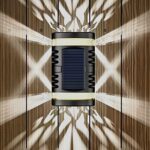
Waterproof solar LED wall light
See also

How to Brighten a Dark Room: Colours, Mirrors and the Right Lighting

Low Ceiling Lighting Ideas: How to Make a Low Ceiling Look Higher

How to Replace a Fluorescent Tube With LED: Wiring Diagrams and Pitfalls
