After falling for the Japanese charm, you must now find the piece that truly fits into your home. Here is how to avoid making a mistake.
Selecting the Shape According to the Desired Atmosphere
Light sculpts your space. A wise choice radically transforms the atmosphere of your daily interior.
Prefer organic shapes for a zen spirit. Conversely, geometric and cylindrical lines adapt better to a resolutely modern living room.
Round structures soften imposing volumes. Angular silhouettes, for their part, structure living spaces with welcome visual precision.
Dare an asymmetrical silhouette. It will elegantly break the sometimes overly rigid codes of your usual contemporary furniture.
Adapting Dimensions to the Surface Volume
Measure your room before checking out. For a 12 m² living room, avoid unnecessarily overwhelming your ceiling. The proportion must remain consistent with the available floor area.
Carefully adjust the height of your pendant light. You must imperatively clear the view. A light fixture placed too low hinders visual circulation and oppresses the living space.
Opt for small formats in your hallways. These passage areas require a certain discretion. Japanese paper retains all its airy lightness here without cluttering.
Checking Compatibility with LED Bulbs
Exclusively use LEDs with low heat emission. Japanese paper remains a sensitive natural material. Protect the paper fibres to guarantee optimal longevity.
Choose a warm colour temperature. Warm white enhances the natural grain of Washi paper. The soothing effect on your eyes is immediate and particularly relaxing.
Always check the socket of your support. Scrupulously respect the indicated maximum power to secure your domestic electrical installation.
A suitable bulb changes the entire final result. It is a major technical detail to enhance your interior decoration.
Once the technique is mastered, let’s move on to pure format. Every corner of the house deserves its own light source. In our collection, Japanese paper is used mainly for pendant lights, plus a chandelier; the ideas below for wall lights and table lamps will help you complete them with other pieces.
Pendant Lights for Central Lighting
Plant fibres filter light with incomparable softness. This noble material ensures perfectly uniform diffusion in the room. The visual result remains homogeneous and soothing everywhere.
A large living space demands a strong and structuring presence. The Japanese paper pendant light then becomes the central element of the decor. It naturally attracts all eyes. Choose a generous volume for the living room.
The elegance of textile cables adds a careful finish to the whole. They brilliantly complement this minimalist style. It is a subtle aesthetic detail that is too often forgotten.
Wall Lights for Elegant Wayfinding
The wall diffuser projects truly subtle shadow patterns. This technique is ideal for poetically animating a bare wall. It transforms a simple wall into a luminous picture.
Wall lights effectively free up floor space. It is a perfect solution for narrow corridors or entrances. You immediately gain fluidity of passage.
Install your light fixtures at eye level for optimal comfort. The paper masks the light source to avoid glare. Visual comfort is thus completely preserved.
In the evening, these strategic light points are perfectly sufficient. The atmosphere of your interior instantly becomes restful. A soft ambience is guaranteed for your relaxation moments.
Table Lamps for Accent Lighting
Easily arrange warm luminous islands in your home. Simply place a designer lamp on a wooden sideboard. This soft light creates an absolutely perfect reading corner.
Move your nomadic lamp according to your desires of the moment. It transforms the atmosphere of a room with a simple gesture. It is the most versatile decorative accessory there is.
Japanese paper soothes the mind just before sleeping. On a bedside table, the light is never harsh on your eyes. It is a healthy and serene choice for the bedroom. We love this cocooning side.
Maintenance to Preserve Paper Quality
But beware, this beauty is fragile. To keep that original lustre, a minimum of care is required daily.
Cleaning the Paper Without Damaging the Fibres
Using a feather duster is ideal. Dust is removed with a light and regular gesture. A dry cloth also works very well for routine maintenance.
There is a formal prohibition of liquids. Water irremediably destroys the paper fibres. Chemical products stain the material. Be extremely careful when cleaning. Never wet the structure.
The frequency of maintenance remains moderate. A quick pass once a month is sufficient. This prevents the accumulation of stubborn dirt and yellowing.
Protecting the Structure from Sources of Humidity
Choose dry rooms. Install your light fixtures in the living room or bedroom. Avoid overly humid environments for the cellulose.
Maintain a distance from water points. Do not place paper near a sink. Splashes are fatal for the integrity of Japanese paper.
Monitor ambient condensation. In winter, air out your rooms well. Stagnant humidity softens the paper and promotes mould.
Well-protected paper lasts for years. It is a durable investment for your interior decoration.
The Services of Our Online Shop
You now know everything about maintenance. Now, discover why you should choose us for your next luminous crush.
Check the Delivery Time of Each Model
Your satisfaction relies on clear delivery times. Our Japanese paper lights ship from our warehouse in China and are delivered in about 8 working days on average; the delivery time of each model is shown on its product page. Delivery is free in the UK on orders over £65.
Fragile materials require maximum protection during transport. We pack each shipment with care. If your light fixture arrives damaged or does not match your order, the legal guarantee of conformity applies. Safety is our absolute priority.
You also have 14 days after receipt to change your mind, with return costs paid by you. Payment is secure, by card, PayPal, Apple Pay, Google Pay or bank transfer.
Benefit from a Wide Choice of Trendy Styles
Discover a varied and modern range for your interior. Explore our many models of Japanese paper pendant lights. We follow the latest current decoration trends.
Our expertise enhances every living space. LightingConcepts.ie masters character lighting with care. We select each model carefully.
Our personalised customer support facilitates all your projects. Our team answers your technical questions with precision, by email at contact@lightingconcept.co.uk, Monday to Friday from 10am to 7pm. Benefit from expert advice for your purchase.
Style, speed and advice come together in our shop. Trust a specialist to enhance your home.
Our Japanese paper lighting in detail
Our Japanese paper lighting is almost entirely made up of pendant lights, plus an LED chandelier in the shape of a large fish. Every model has a Japanese style, some Japandi or minimalist. White shades come first (more than half of the models), followed by beige, with a few brown or blue touches. The paper is combined with metal on about a third of the models, and occasionally with wood.
Shapes vary: balls and spheres, lanterns, a cone, an ellipse, a flower or pleated paper, as with the Japanese paper ball pendant light, the Japandi ellipse rice paper pendant light and the large white Japanese pleated paper pendant light. Which Japanese paper light for which room? All suit a living room and nearly all a bedroom; a large shade suits a dining table, a smaller one a hallway. Most take an E27 bulb and come with their bulb, and all ship from our warehouse in China.
Frequently asked questions about Japanese paper lighting
Which bulb should you use in a Japanese paper lamp?
Use an LED bulb, which gives off very little heat, and respect the maximum wattage shown on the product page. A warm white, around 2700 K, brings out the texture of the paper. Most of our models take an E27 bulb.
Is rice paper the same as Japanese paper?
In lighting, rice paper is the usual name for the thin, translucent paper of Japanese lanterns, which is generally made from plant fibres rather than rice. Both names describe the same soft, diffused light.
How high should you hang a Japanese paper pendant light?
Above a dining table, leave about 70 to 80 cm between the table top and the bottom of the shade; in a passageway, keep at least 2 metres of clearance. For a hardwired ceiling connection, call a qualified electrician.

 Price range: £249.99 through £307.99 Add to cart - £307.99 This product has multiple variants. The options may be chosen on the product page
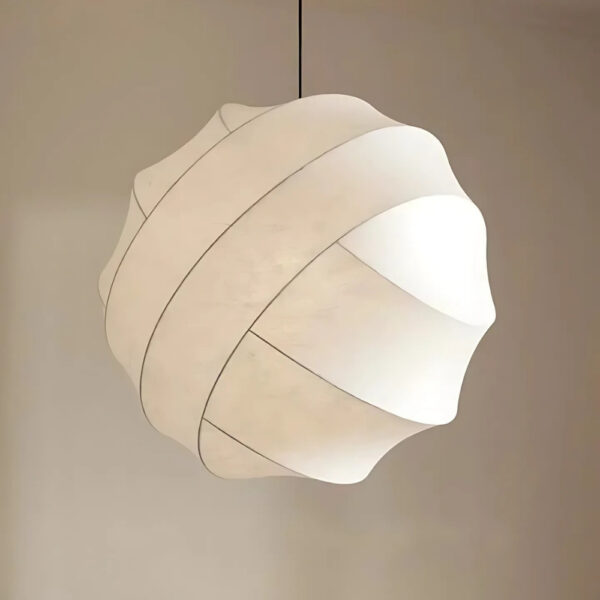 Price range: £233.99 through £482.99 Add to cart - £482.99 This product has multiple variants. The options may be chosen on the product page


 Price range: £297.99 through £344.99 Add to cart - £344.99 This product has multiple variants. The options may be chosen on the product page
 Price range: £155.99 through £164.99 Add to cart - £164.99 This product has multiple variants. The options may be chosen on the product page


 £307.99 Add to cart - £307.99 This product has multiple variants. The options may be chosen on the product page


