

Table of Contents
Urban jungle interior design comes down to three things: deep greens laid over warm browns, woven plant materials such as rattan and cane, and light that is filtered, warm and low. The third one is what separates a planted room that lasts from a party decoration, and it is the one nobody bothers to explain.
Search “jungle decor” from the UK and the first page is mostly a children’s party: a children’s jungle bedroom, safari balloon kits, shopping listings and pinboards of paper vines. Exactly one interiors page reaches page one, and it is about the urban jungle. That is the version this guide covers, the one that stays up all year.
Three looks share the name jungle decor
Three different intentions use the same vocabulary. Knowing which one you are in avoids most of the mistakes.
- The urban jungle. Plants make the room, not patterns: pale or deep green walls, plain furniture, natural fibres, twenty to forty pots in different sizes. The easiest version to live with, and the hungriest for daylight.
- The tropical print. The foliage is drawn rather than grown: panoramic wallpaper, big leaf cushions, botanical prints. Real plants become an extra, and the room dates faster.
- The jungle party. Balloons, cardboard animals, plastic palm leaves. Fine for a birthday, but nothing in it is built to last.
Four details tip a planted room into the temporary camp: glossy plastic palm leaves laid flat on a surface, the same exotic animal repeated from a cushion to a print to a mug, an apple green that exists in no wood anywhere, and a single ceiling light in the middle of the ceiling, which flattens the plants and kills every shadow. That last one takes up half of this guide.
The palette: greens laid over warm browns
A wood is not green. It is green and brown, and the proportion makes the style: greens in large blocks, warm browns underneath, very little else.
The greens that hold have yellow or grey in them: sage, olive, khaki and eucalyptus among the pale shades, fir, bottle and English green among the deep ones. Blue greens, mint and duck egg belong to other styles and go flat the moment the light turns warm. The browns come from materials rather than paint: natural rattan, oiled pale timber, walnut, terracotta, tan leather. The accents fit on one hand: ecru and linen on fabric, brass on metal, matt black on frames. Keep roughly 60 per cent dominant, 30 per cent secondary, 10 per cent accent.
The pairings themselves fill a guide of their own: what colour goes with green explains why a green never behaves the same way twice.
Rattan, cane, bamboo and woven fibre in front of a bulb
Four materials hide behind “natural fibre”, and they do not do the same job in front of a bulb.
- Rattan is the stem of a climbing palm, solid right through and pliable once heated. It is bent into structures: lamp bases, shade frames, chairs.
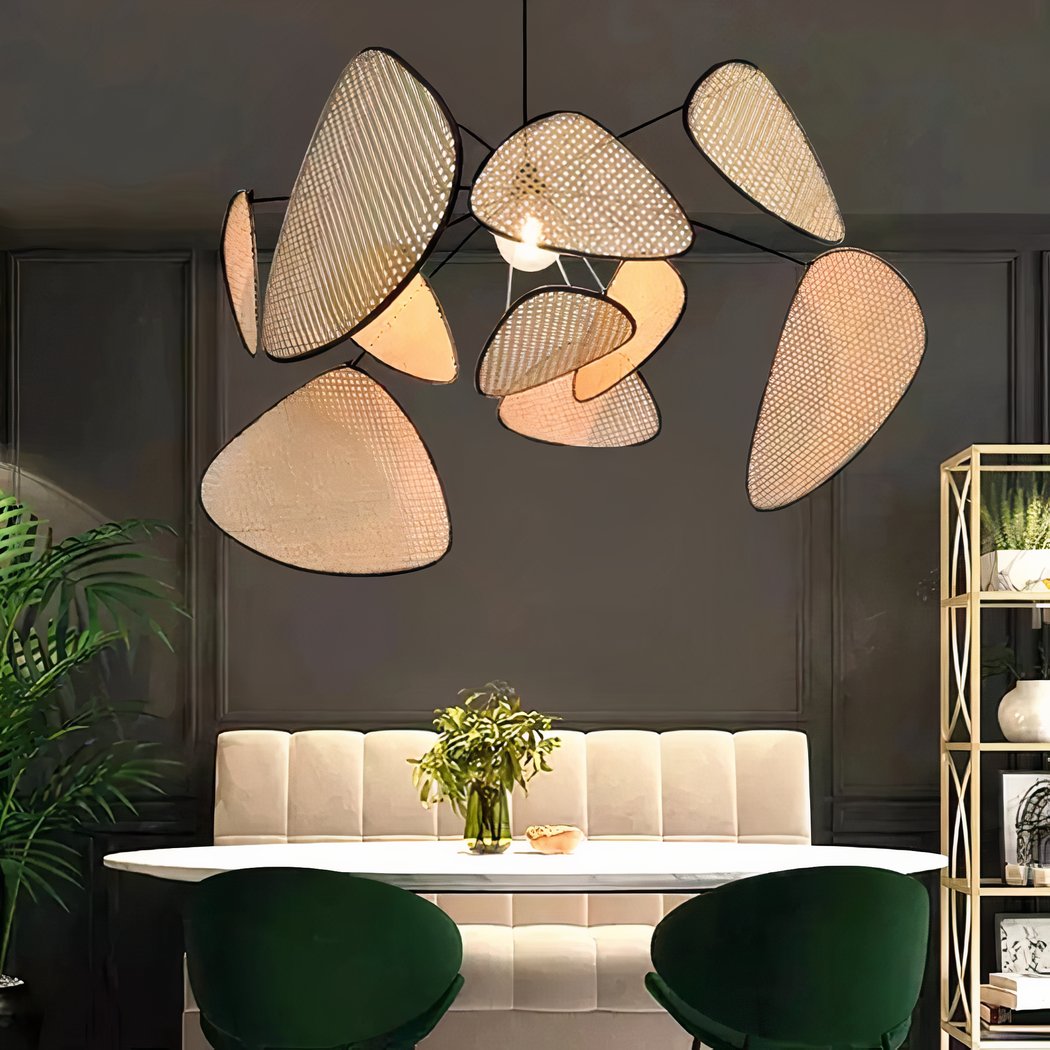
- Cane is the bark of that same rattan, split into strips and woven into a regular grid. It gives the open, perforated surfaces, and it filters light better than anything else here.
- Bamboo is a hollow, rigid stem that will not bend. It is worked in straight sections, which is where slatted pendants come from.
- Jute, willow and raffia are coarser, matt fibres that soak light up instead of letting it through. Excellent underfoot and in baskets, disappointing as a shade.
One rule follows. In front of a bulb, choose an open weave, cane or spaced slats. Under the light, on the floor or in a basket, choose a matt fibre for texture. Our rattan pendant light and natural fibre pendant light ranges cover both families, while the slat shades in our wooden pendant light range throw sharp rays across the ceiling rather than a soft halo.
Filtered light is the real signature of the look
Here is what no urban jungle page tells you, however many ideas it lists. What makes woodland recognisable is neither its colour nor its plants, it is its light: it arrives in patches, comes from several directions, draws cut out shadows, and stays warm because it has passed through leaves. One opal ceiling light in the middle of your ceiling does the opposite, a flat even wash with no direction and no shadow.

Three settings rebuild it at home.
- An open shade, never a closed diffuser. Cane, timber slats and loose weaves let part of the output through and hold the rest back, so the light leaves the fitting as a pattern. Opal glass rubs every pattern out.
- Three sources instead of one, and lower down. A pendant over the table, a wall light behind a large leaf, a lamp on the floor inside a planter. A fitting placed behind a plant throws its shadow across the wall, the most striking effect in the style and the cheapest. Where the ceiling rose sits in the wrong place for that, our guide to the off centre ceiling light covers moving it without touching the wiring.
- Distance to the wall sets the sharpness. The closer the shade sits to a surface, the smaller and crisper the shadow; the further away, the larger and softer. A clear filament bulb draws a sharp pattern, an opal bulb a gentle halo. Whether you can turn that pattern down at all is decided by a third line on the box: our guide explains the dimmable meaning and where to check it.
For fittings made with that in mind, see our jungle pendant light selection. The same logic of fibre and low light, with a quieter palette, runs through our guide to japandi style.
2,700 K and CRI 90: what the bulb does to your greens
Green is the least stable colour in decorating: it depends almost entirely on the source lighting it. Two figures, printed on every bulb box, decide the result. Colour temperature, in kelvins, gives the tint. At 2,700 K the spectrum holds plenty of red and orange and little blue, which is what saturates rattan and terracotta; the downside is set out in our comparison of cool white vs warm white, because it greys out the cold greens. The colour rendering index, written Ra or CRI, says how faithfully a lamp renders colour on a scale running to 100, and it decides whether your foliage looks alive or plastic.
| What you are lighting | Under 2,700 K, Ra 80 | Our advice |
|---|---|---|
| Bright green foliage | Dull, slightly grey | Ra 90 at least, 2,700 or 3,000 K |
| Sage or olive wall | Holds well, its yellow is saturated | 2,700 K without reservation |
| Fir or bottle green wall | Darkens and swallows the light | Double the lumens, keep 2,700 K |
| Rattan, cane, pale timber | Gain warmth and relief | 2,700 K is their best light |
| Terracotta and brass | Come alive, which is the point | Do not go above 3,000 K |
For a planted room we recommend 2,700 K everywhere, Ra 90 or better, and more lumens rather than more kelvins if it feels dark. Going up to 4,000 K to see the green properly is the commonest false good idea: the room becomes accurate, and cold.
What your plants actually get in a British room
Are your lights helping your plants? The honest answer is no, and one order of magnitude settles it.

By day, under an overcast sky, a plant on the window sill gets 2,000 to 10,000 lux. A metre into the room only 500 to 2,000 are left, and three metres back, 100 to 300 lux. In the evening, under a ceiling light, it gets 50 to 150 lux for four or five hours. The gap between the sill and the back wall is a factor of twenty to fifty, and no decorative fitting closes it. The kind of light matters too, since a plant only uses radiation between 400 and 700 nm, and an LED at 2,700 K holds little blue.
British daylight sharpens the point. Met Office averages run from around 1,200 hours of sunshine a year in parts of Scotland to over 1,700 on the south coast of England, and in late December the sun is above the horizon for under eight hours in London and barely seven in Edinburgh, much of that behind cloud. A deep Victorian terrace or a north facing back room loses more again. So move the plant, not the lamp: big leaves near the glass, tolerant species at the back. A hall with no window at all is the extreme version of that problem, and our guide to narrow hallway lighting ideas works through what to fit in one.

Which leaves the opposite solution, often the better one: instead of lighting your plants, make them part of the fitting. A planter pendant puts the foliage at eye level and sends its beams down onto the table. Trailers take to it very well: pothos, ivy, string of hearts, tradescantia.
Urban jungle interior design: your questions answered
How do I make my living room look like a jungle?
Start with the daylight: keep the spots that read more than 500 lux for the big leaves. Lay a base of greens and warm browns in large blocks rather than small objects, add rattan and cane, then three warm sources at three heights. A room that works has a few well placed plants, not a lot of badly lit ones.
What does urban jungle mean?
It is the name for an interior where houseplants, rather than patterns or furniture, carry the room: many pots in different sizes, natural materials, and a green and brown palette borrowed from woodland. It began as a social media trend around 2015 and has settled into a mainstream look. The jungle is the planting, not a safari theme.
How do I make my room feel like a forest?
Copy the light before the leaves. Woodland light arrives in patches from several directions, stays warm, and is broken up by whatever it passes through. Swap the single opal ceiling light for two or three warm sources lower down, put one behind a large plant so it casts a leaf shadow, and use an open weave shade.
Which plants give the best jungle effect?
Large cut leaves do it with a single plant: monstera, philodendron, kentia palm, bird of paradise, fiddle leaf fig. Fill in with easy trailers, pothos, ivy and tradescantia, which cope with moderately lit spots. Mix three sizes, tall on the floor, medium on a unit, trailing up high, biggest leaves nearest the window.
Can a lamp replace daylight for my plants?
Not a decorative one. On a window sill a plant gets 2,000 to 10,000 lux by day, against 50 to 150 lux in the evening under a ceiling light, and only for a few hours. An LED at 2,700 K holds little blue, while a plant uses radiation between 400 and 700 nm. A windowless room needs a horticultural lamp.
Which bulb should I choose for an urban jungle room?
An E27 or B22 LED at 2,700 K with a colour rendering index of at least 90: the warm tint saturates rattan and terracotta, the high index stops foliage looking grey. Pick a clear filament bulb for well drawn leaf shadows behind an open shade, an opal bulb for a soft halo. In a dark room, raise the lumens.
Sources
- Illuminance, Lux and Light meter, encyclopaedic articles. Orders of magnitude for indoor illuminance. Wikipedia
- Rattan, Caning and Bamboo, encyclopaedic articles. Origin and working of woven plant materials. Wikipedia
- Photosynthetically active radiation, encyclopaedic article. The 400 to 700 nm band plants use. Wikipedia
- UK climate averages, sunshine duration. Annual sunshine hours by region. Met Office
- BS EN 12464-1, Light and lighting, lighting of work places. Families of white light and colour rendering. BSI
Related products
Bohemian chic pendant light in braided rattan and natural wicker
See also

Mood Lighting: The Three Settings That Really Create It, Room by Room

How to Change a Spotlight Bulb, Even With No Clip or Spring

Conservatory Lighting: Fixings, Lumens and the Black Mirror After Dark
