
Table of Contents
A light that stays on when the switch is off is usually an LED glowing on a residual current of a fraction of a milliamp: an illuminated switch, a two-wire dimmer, smart switch or sensor, current induced between neighbouring cables, or a switch wired in the neutral. Four tests tell them apart; only the switched neutral is dangerous.
Electricians call it LED ghosting, and it is rarely new. The same current was already flowing in plenty of homes in the days of filament bulbs, unseen, because a filament needs watts before it glows, while an LED lights up on about a thousandth of the current it draws when it is on. By changing their bulbs, millions of British households fitted a fault detector without knowing it. This guide sorts the causes, gives the tests that separate them without opening anything, and says which ones can be put right, which can be worked around, and which needs a registered electrician.
Faint glow or full brightness: two different problems
Look closely at the light first, because “stays on” covers three situations with nothing in common.
- It fades out within a few seconds. An LED that dies away two to ten seconds after you switch off is normal: the capacitor in its driver, the small power supply inside the bulb, is emptying. There is nothing to fix.
- It glows faintly, or flashes every few seconds, all night. That is LED ghosting: a tiny current still reaches the bulb with the switch off. The rest of this guide deals with it.
- It stays fully lit. The switch is no longer controlling the light at all. The usual reasons are a switch whose contacts have stuck closed, as worn bathroom pull-cord switches do, or a new fitting connected at a loop-in ceiling rose to the permanent live instead of the switch wire. A smart bulb or a fitting with its own remote can also keep itself on, but that is just a setting.
A light at full brightness that the switch cannot turn off is a wiring fault until proven otherwise: switch the circuit off at the consumer unit and call a registered electrician. None of the fixes below applies to it.
Why an LED shows what a filament bulb hid
An incandescent bulb is a resistor. To give off light, its filament has to reach around 2,500 °C, and that takes nearly all of its rated power. With 0.2 milliamps flowing through it, an old 60 W bulb dissipates less than a tenth of a milliwatt, under a millionth of what it would need: the filament stays cold, the bulb stays dark, and yet the current is there.
An LED works quite differently. Its chips emit light on a current of a few microamps, and the driver that feeds them contains a capacitor. A tiny current takes seconds to charge it; once the voltage is high enough, the LEDs light for as long as the capacitor takes to empty, then the cycle starts again. Hence the two classic symptoms: a very faint steady glow, or a short flash every few seconds when the current is only enough to top the capacitor up in bursts.
The third player is your eye. The International Commission on Illumination places scotopic vision, the night vision of the rods, below 0.005 candela per square metre: that is the light level of a bedroom with blackout curtains drawn, and in it the eye notices what it ignored by day. The same bulb can be invisible at 7 pm and unbearable at 3 am, while the electrical fault has not changed at all.
The five causes of a faint glow, and how to tell them apart
Each cause leaves its own clues, and the table matches what you can see with the most likely explanation.
| What you see | Most likely cause | Risk | Who deals with it |
|---|---|---|---|
| A steady faint glow, and the switch shows a small light in the dark | A locator light across the switch contacts | None | A switch change, not notifiable work |
| A glow or regular flashes, on a light run by a dimmer, sensor, timer or smart switch | A two-wire control with no neutral, powering itself through the lamp | None | Another control or another bulb; an electrician if a neutral must be run |
| A very faint glow, no locator light, no electronics, long cable runs or two-way switching | Capacitive coupling between the switch wire and a neighbouring live core | None | Another bulb or a bypass |
| A clear glow, sometimes on several lights of one circuit, and a non-contact tester reacts at the fitting with the switch off | The switch breaks the neutral instead of the live | Real | A registered electrician, without exception |
| The glow depends on the position of the two switches of a two-way circuit | Strappers mixed up, or the neutral used as a strapper | Real if the neutral is involved | A registered electrician |
The illuminated switch, and why not every one is guilty
A switch can carry two kinds of light that look alike and work in opposite ways. A locator light, usually a small neon or LED, helps you find the switch in the dark: it shines when the lamp is off, because it is connected across the switch contacts, and its current has only one way back to the neutral, through the lamp. An indicator that shows a circuit is on, as on many fan or heater switches, is connected across the load instead: it needs a neutral in the box and never causes ghosting.
The current involved is counted in milliamps: Legrand gives 2.4 mA for its 230 V LED locator module. With an old 60 W bulb nothing showed; with an LED of 5 or 9 W it is enough. Neither part is faulty, the two technologies simply do not go together, and Legrand lists illuminated switches among the uses of its active compensator.
Two-wire dimmers, smart switches and sensors
A dimmer, a motion sensor, a timer or a smart switch has to stay powered all the time. Most UK switch boxes hold only the switch wires and the earth, because the neutral stops at the loop-in ceiling rose, so these controls are mostly sold in two-wire versions that draw their own supply through the lamp. Their instructions therefore set a minimum load, 3 W on Legrand’s two-wire sensors; below it, the light may glow, flicker or refuse to go off. Our guide to the dimmer switch explains that load sum, the pitfalls with LEDs and the difference between two-wire and three-wire models.
Induced current: long runs and two-way switching
Two insulated conductors running side by side for several metres form a capacitor. Its capacitance is tiny, but it lets an alternating current through. Legrand describes the mechanism in so many words in the data sheet of its compensator: over long cable runs, capacitive coupling creates a leakage current which, with low-power loads such as LEDs, can light the load while the switch is off. British homes are well placed to produce it, since 2 way switch wiring runs a three-core cable between the two switches, with the two strappers lying side by side the length of the stairs, one live and the other not. The sum fits on one line: the current equals the voltage multiplied by 2πfC, so 230 V times 314 times the capacitance.

Keep the order of magnitude: a few tens to a few hundred microamps, hundreds of times less than the 78 milliamps or so that a 9 W LED draws when it is on (twice 9 W divided by 230 V, because these small drivers often have a power factor of about 0.5). Nothing in the installation is faulty; the only thing that changed is the bulb.
A switch in the neutral
This one is of another kind. If the switch is connected in the neutral, the lamp goes out because the circuit is open, but the fitting stays connected to the live the whole time. A leak to earth, through the filter in the driver or the metal body of the fitting, is then enough to make the LED glow, often more clearly than in the other cases, and sometimes on several lights of the same circuit.
The fault is not the glow, it is the wiring. A fitting you believe is dead stays at 230 V, including a lamp holder that stays live with the bulb taken out: our guide on how to wire a lamp holder shows why its terminals are the most exposed part. BS 7671, the IET Wiring Regulations, requires every single-pole switch to be in the line conductor only, and an electrician checks it with a polarity test. If your tests point here, the circuit needs a registered electrician.
Four tests to find your cause, without opening anything
Do them in order: each rules out a family of causes.
Test 1: swap the bulb
Switch the circuit off at the consumer unit first, since one of the causes leaves the lamp holder live, then take out the glowing LED and try it in a table lamp. Put another LED in the suspect fitting. If the glow follows the bulb, that bulb is unusually sensitive and replacing it is enough. If it stays with the light point, the cause is in the circuit. You still have to get the bulb out: our guide on how to change a spotlight bulb covers downlights with no clip or spring, the fitting that resists most.
Test 2: add a load
Fit a second bulb in the same fitting if it has several lamp holders, or try a higher-wattage LED, or an old filament or halogen bulb if you still have one. If the glow stops, the proof is made: the residual current is too weak to light a normal load. You are in one of the first three cases in the table, none of them is dangerous, and a bypass will work.
Test 3: look at the control
A small light on the switch means a locator light. A dimmer, sensor, timer or smart switch means a two-wire control. A light switched from two places means two-way switching: try the four combinations of the two switches. If the glow appears only in some of them, the strappers are wired wrongly, and that circuit deserves a check before anything else.
Test 4: look for the live with a non-contact tester
A non-contact voltage tester, the pen that beeps near a live conductor, gives the last clue. With the switch off, hold it near the cable at the fitting without touching anything, having first tried it on a light that works normally so that you know how it responds. If it reacts clearly while the lamp is supposed to be off, the live is probably still there: stop and call a registered electrician. Never read it the other way round. It can react to a cable that merely runs next to a live one, and the Health and Safety Executive’s guidance on test equipment says that such detectors are only for identifying live equipment, never for proving that it is dead.
Before anything is opened: isolate, prove dead, know when to stop
Nothing that follows is done live. Switch the circuit off at the consumer unit, not just at the wall switch: at a loop-in ceiling rose, the permanent live that feeds the other lights is still there with the switch off. Electricians then prove absence of voltage on every conductor, neutral included, with a two-pole voltage indicator checked on a known live source or a proving unit before and after use. A multimeter or a non-contact tester does not do that job.
Colours will not settle anything on their own. Brown is the live, blue the neutral, green and yellow the earth, with red and black in older UK homes, but in a switch cable the blue or black core is usually a switch wire, which is live when the switch is on and should carry a brown sleeve. Changing a switch like for like is not notifiable under Part P of the Building Regulations in England, but it must still meet BS 7671; a new circuit, a new consumer unit or any work in the zones of a bathroom is notifiable, and is done by a registered electrician, a member of a competent person scheme such as NICEIC or NAPIT, or notified to building control first. Wales has similar rules, while Scotland and Northern Ireland have their own. Electrical Safety First, the UK electrical safety charity, advises using a registered electrician rather than doing the work yourself.
Three findings stop any DIY: the live present at a fitting with the switch off, a two-way circuit that uses the neutral as a strapper, and any box where the earth is missing or cut. In all three, the glowing LED is the least serious symptom of the problem.
The fixes, from a real repair to an honest workaround
In order of how clean they are: the first three remove the cause, the last three get round it.
Replace the illuminated switch. A plain switch with no locator settles the most common case for good, for a few pounds.
Have the wiring corrected so the switch breaks the live. It is the only answer to a switched neutral, and a job for a registered electrician. Ask at the same time for a neutral to be run to the switch boxes: it will let you fit a three-wire dimmer or smart switch later without meeting the same fault.
Move the two-wire control to its three-wire version. Where a neutral is present, the version of the same dimmer or sensor that uses it stops drawing its supply through the lamp.
Change the bulb. A higher-wattage LED takes a given leakage without reacting, a fitting with several lamp holders shares it out, and models differ widely: some glow on a current that leaves others dark. When the cause is capacitive, this is often all it takes. Our guide to LED bulbs explains what to read on the box, and the one on the dimmable meaning shows how to check a bulb before it goes behind a dimmer.
Fit a bypass. It is sold as an LED bypass, a load corrector or an anti-ghosting capacitor, and makers of wiring accessories offer an active version, connected at one light of the circuit, for lamps of 5 to 300 W, one per control. It diverts the residual current away from the LED rather than removing it, and uses up to 1.5 W itself. Our view: it makes sense when the cause is capacitive or a locator light must stay, never to hide faulty wiring. Ask your electrician to fit it.
Choose a light with its own switch. When only one light is affected, this is often the simplest route: the supply is broken downstream of the whole installation, right before the lamp holder, and no residual current reaches the bulb.

What it costs, and the bulbs and fittings that resist it
The running cost is small. A capacitive current is almost entirely reactive and uses next to nothing; a switch locator light is quoted at 0.2 to 0.7 W, at most about six kilowatt hours a year, or around £1.50 at 25p per kWh, for example. That is not what should decide you.
Wear is plausible but not documented. BS EN 62612, the standard for LED lamps with a built-in driver, states that a maker’s life claim cannot be verified with confidence within practical test times: it measures lumen maintenance over a limited period and sets endurance tests, including repeated switching of the supply. A driver kept under a weak excitation day and night works outside those conditions, nobody publishes a figure for it, and we will not invent one.
The bedroom is where the nuisance is most concrete. A steady glow is bearable; a slow flash, which is what a current topping up the capacitor in bursts produces, reminds you of itself each time it fires. In a room where you are trying to sleep, it is the best reason to fix the fault rather than get used to it, and a reading wall light at the bedside, its head aimed at the page, lets the rest of the room stay dark while you read. If your problem is a flicker with the light on, not a glow with it off, the diagnosis is different, and it is set out in our guide to flickering lights.
When you buy, four points lower the risk, even though no maker advertises them as such. Wattage: of two bulbs that suit the fitting, the more powerful is the less sensitive, and a 2 W LED on a two-wire sensor is the worst case. The number of lamp holders: a fitting with three or five bulbs shares the residual current between them, and the visible threshold is rarely reached. The diffuser: an opal diffuser cannot stop the glow, but it spreads it over a large surface, far less visible in the dark than a bare bulb.
A bulb you can change matters most. A B22, E27 or GU10 lamp holder lets you try another bulb in thirty seconds, the first test in this guide; with integrated LEDs that door is closed, and the cause has to be dealt with in the installation. It counts for a light run by a sensor or a dimmer, and every one of our LED lights says on its product page whether the light source can be replaced.
A flat round ceiling light with a white diffuser sums up the last two points: 25 cm across and 11 cm deep, it takes an E27 bulb that you can swap in seconds, and its opal disc spreads whatever glow remained over close to 500 cm² instead of the glass of a bare bulb.
Light stays on when the switch is off: frequently asked questions
Why does my LED bulb not turn off completely?
Because a residual current still flows through it with the switch off, usually from a locator light in the switch, from a two-wire dimmer, sensor or smart switch, or from capacitive coupling between cores of a cable. A fraction of a milliamp never lit a filament bulb, but it makes an LED glow.
Is LED ghosting dangerous?
Usually not: the current is below a few milliamps and the installation is not faulty. The exception is a switch wired in the neutral instead of the live, which leaves the fitting at 230 V while you think it is dead. A non-contact tester held near the fitting with the switch off points to it, and it calls for a registered electrician.
Does a light fitting still have power when the switch is off?
It should not, as long as the switch breaks the live, which BS 7671 requires. But a loop-in ceiling rose still carries the permanent live that feeds the other lights, and a switch wired in the neutral leaves the whole fitting live. Before touching a fitting, switch the circuit off at the consumer unit and have absence of voltage proved with a two-pole tester, not a non-contact pen.
Do I need a bypass capacitor for LED lights?
Only if the cause is a locator light you want to keep, a two-wire control or induced current, and another bulb has not cured it. A bypass diverts the residual current rather than removing it and uses up to 1.5 W itself. Buy a ready-made one rated for your control, have an electrician fit it, and never use it to hide a switched neutral.
Is it normal for LED strip lights to glow when off?
It is common, and usually for the same reasons. The residual current reaches the strip’s power supply and charges its output capacitor, which then feeds the whole length. The fixes are the same, and the simplest is often to run the strip from a switched socket or its own controller.
How much does it cost to leave an LED glowing all night?
Very little. A capacitive current uses next to nothing, and a switch locator light is quoted at 0.2 to 0.7 W, at most about six kilowatt hours a year: around £1.50 at 25p per kWh, for example. Wear on the bulb and the nuisance in a bedroom are better reasons to fix it.
Sources
- BS 7671, Requirements for Electrical Installations, the IET Wiring Regulations: single-pole switches in the line conductor only, polarity checked at inspection; Approved Document P, Electrical safety: dwellings, notifiable work in England. IET, BSI and GOV.UK
- Electrical test equipment for use on low voltage electrical systems, Guidance Note GS38, fourth edition, 2015: non-contact detectors for identifying live equipment only, test devices proved before and after use. Health and Safety Executive
- Electrical safety advice for DIY-ers: use a registered electrician. Electrical Safety First
- Active compensator, technical data sheet F02436FR/02: capacitive coupling on long cable runs, two-wire controls and illuminated switches. Legrand
- Scotopic vision, International Lighting Vocabulary, term 17-22-017. International Commission on Illumination
- BS EN 62612, Self-ballasted LED lamps for general lighting services: lumen maintenance and endurance tests including supply switching. BSI
Related products

Modern Minimalist LED Chandelier with Cylinder and Recessed Spotlight

Adjustable brass wall light
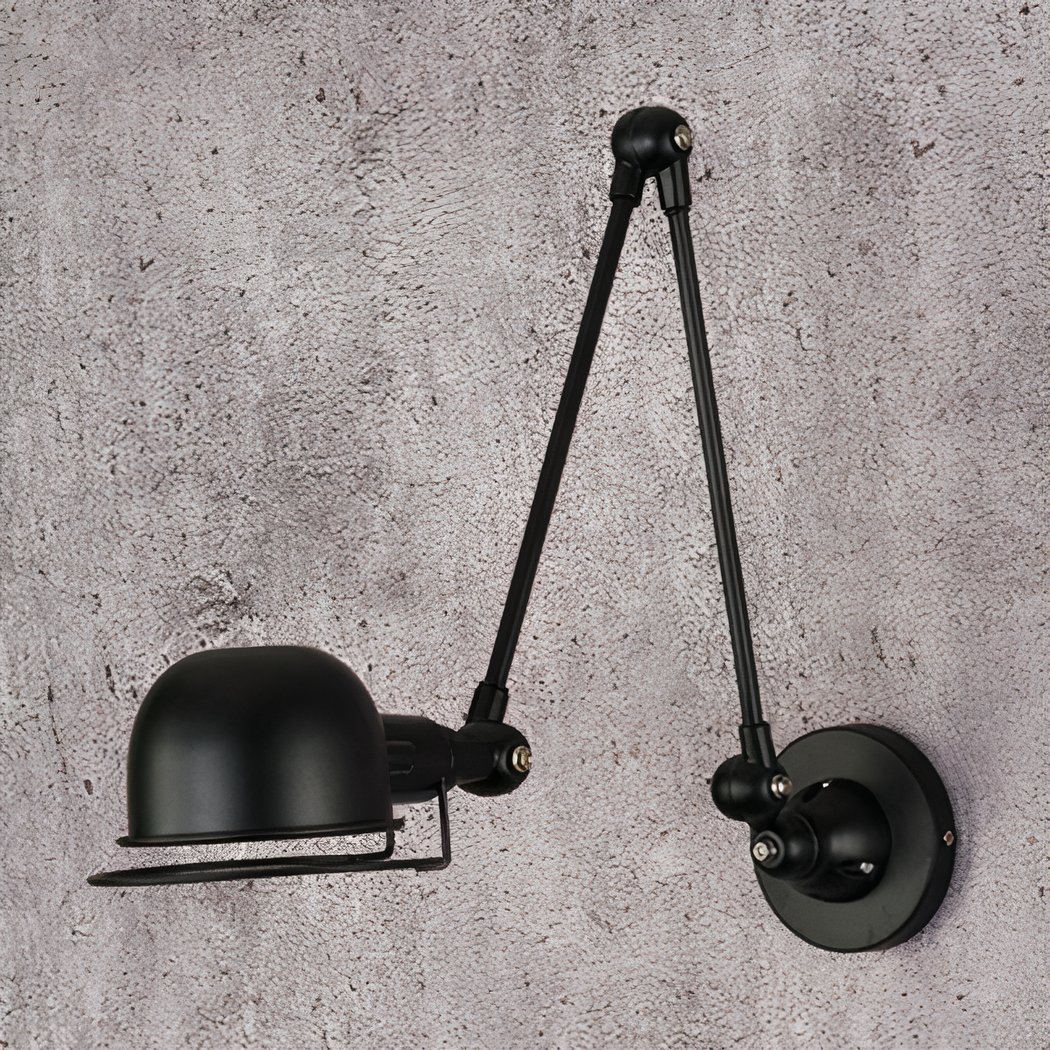
Retro adjustable black industrial LED wall light
See also

Light Stays On When the Switch Is Off: The Five Causes and the Tests That Tell Them Apart

Sloped Ceiling Lighting: What Works in a Loft Conversion, and What to Avoid

Mood Lighting: The Three Settings That Really Create It, Room by Room
