
Table of Contents
A light bulb uses its wattage multiplied by the hours it is on. An 8 W LED uses 0.008 kWh in an hour, about 0.21p at the Ofgem price cap of 26.32p per kWh that applies from October to December 2026. Three hours a night for a year costs £2.31; the same light from an old 60 W bulb cost £17.29.
The arithmetic fits on one line. What helps is comparing bulbs that give the same light, then setting the total against a real British bill.
The sum: watts, hours and your unit rate
A watt is a rate: how fast the bulb draws energy. A kilowatt-hour, the “unit” on your bill, is an amount: what 1,000 W uses in an hour. “Watts per hour” means nothing; your bill counts units. Three steps:
- multiply the wattage of the bulb by the hours it is on;
- divide by 1,000 to get kilowatt-hours;
- multiply by the unit rate on your bill.
An 8 W LED lit three hours a day uses 8 × 3 = 24 watt-hours, or 0.024 kWh, a day. Over a year, 8 × 1,095 hours = 8.76 kWh, or £2.31 at the rate used in this guide. Amps play no part either: a 3 W LED on 230 V mains draws 3 ÷ 230, about 0.013 A on paper, a figure for fuses and cables, not for your bill.
For the rate, we use the Ofgem energy price cap. From 1 October to 31 December 2026, the average capped unit rate for electricity paid by Direct Debit in England, Scotland and Wales is 26.32p per kWh, with a standing charge of 54.83p a day, and Ofgem notes that there is no VAT on electricity until 31 March 2027. The cap is reset every three months, next on 1 January 2027, and does not cover Northern Ireland.
So do not treat 26.32p as fixed. Take the unit rate from your own bill and scale every figure here in proportion: at 20p, take off almost a quarter; at 33p, add a quarter. The standing charge, about £200 a year, is paid whatever your bulbs.
How much electricity a light bulb uses per hour, by type
An 8 W LED and a 60 W bulb can only be compared if they give the same light, so we compare in lumens. Under S.I. 2021/1095, the 2021 lighting ecodesign regulations for Great Britain, a bulb may only claim to replace a 60 W incandescent bulb if it gives at least 806 lumens: the light of a reading lamp.
For those 806 lumens, an incandescent bulb drew 60 W. A clear halogen bulb was capped at about 52 W by the 2009 ecodesign formula, which applied in Great Britain until 2021. A typical class F LED draws about 7.3 to 9 W, and we take 8 W. The best, in class A, need 3.8 W.
| For 806 lumens | Power | Per hour | Per year (1,095 h) | Cost a year |
|---|---|---|---|---|
| Incandescent | 60 W | 0.060 kWh, 1.58p | 65.7 kWh | £17.29 |
| Halogen | 52 W | 0.052 kWh, 1.37p | 56.9 kWh | £14.99 |
| LED, class F | 8 W | 0.008 kWh, 0.21p | 8.8 kWh | £2.31 |
| LED, class A | 3.8 W | 0.0038 kWh, 0.10p | 4.2 kWh | £1.10 |
That is three hours a day at 26.32p per kWh. Between the hungriest and the most frugal of the four, the gap is £16.19 a year, for exactly the same light.

Halogen is still fitted in many British homes: GU10 downlights, desk lamps, capsule bulbs in wall lights. Most halogen bulbs can no longer be placed on the market in Great Britain, but swapping the ones you have for LED saves £12.68 a year per light at three hours a day, the best change you can make.
For other wattages, our lumens to watts chart gives the output to look for. And if a fitting marked “max 40W” makes you wonder about a 60W bulb in a 40W lamp, that limit is about heat, not your bill.
Watts measure electricity, lumens measure light
With filament bulbs, watts were a fair guide to brightness. Not any more: two 8 W LEDs can give 680 or 1,000 lumens depending on their class. The figure to read is efficacy, in lumens per watt, graded on the British energy label since 1 October 2021: class A from 210, B from 185, C from 160, D from 135, E from 110, F from 85. An 806 lumen bulb drawing 8 W runs at 101. The label also gives kWh per 1,000 hours, which is simply the wattage: 8 kWh, or £2.11, for 1,000 hours of an 8 W bulb.

Fittings with built-in LEDs read the same way. Our ring chandelier declares 32 W for 4,231 lumens in warm white: 132 lumens per watt, the light of five 806 lumen bulbs for about £9.22 a year at three hours a day. Size the light first: our guide how many lumens do I need puts a 25 m² living room at about 5,000 lumens, roughly 50 W of ordinary LEDs, or £14 a year. And at equal lumens, a high colour rendering index makes a room look brighter at no cost on the bill.
One bulb, a five-light pendant, a seven-light spider: a year of running costs
Nobody lights a home with one bulb. With our 8 W LED, three hours a day:
- one bulb: 8.76 kWh a year, or £2.31;
- a five-light pendant: 40 W, 43.8 kWh, or £11.53;
- a seven-light pendant: 56 W, 61.3 kWh, or £16.14.
Seven LED points cost less to run than one old 60 W bulb did: plenty of light, spread over several sources, has become cheap. A 7-bulb spider pendant light takes E27 bulbs of up to 15 W in LED; with 8 W bulbs, it costs £16.14 a year, where seven 60 W filament bulbs would draw 420 W and cost £121.05.
What counts now is the technology of each light, then its hours: six hours a day costs twice as much as three. Watch the lights that burn with nobody looking: outside lights, the landing, the garage, a child’s night light.
How much of a UK household’s electricity goes on lighting
Lighting is not what makes a British electricity bill. The Department for Energy Security and Net Zero splits household electricity by end use in its Energy Consumption in the UK statistics, here for 2025:
| End use | Electricity in UK homes, 2025 | Share |
|---|---|---|
| Appliances and electronics | 65.0 TWh | 67.5% |
| Space heating | 14.7 TWh | 15.3% |
| Cooking | 8.5 TWh | 8.9% |
| Water heating | 4.0 TWh | 4.2% |
| Lighting | 3.9 TWh | 4.1% |
| All household electricity | 96.2 TWh | 100% |
Converted from thousand tonnes of oil equivalent (1 ktoe = 11.63 GWh), shares calculated by us.
Lighting takes about 4% of household electricity, less than half of what cooking takes. If your bill has jumped, look at heating, hot water, the tumble dryer and appliances before the bulbs. And since light costs so little, there is no reason to go without: a second lamp or a reading light left on all evening costs pounds a year, not tens of pounds.
Four lighting myths about the bill
Switching off for two minutes. Worth doing, but two minutes of an 8 W LED is 0.27 Wh: four times a day for a year, about 10p. The old advice to leave lights on if you were coming back soon came from fluorescent tubes, whose electrodes wore at every start. An LED comes on instantly at full power, and we see no reason to keep the habit.
The standby of remote-controlled lamps. This one is real. A lamp run by remote, app or voice keeps a receiver powered when it is off. In Great Britain, S.I. 2021/1095 caps that at 0.5 W, in standby and networked standby alike, without adding the two; Northern Ireland follows the equivalent EU rule. At 0.5 W all year, that is 4.38 kWh, about £1.15, half of what an 8 W LED costs lit three hours a day. Our smart connected LED corner floor lamp is one of these. Fit them where you use the features, as our guide to smart bulbs suggests, and turn the wall switch off before a long holiday.
The LED that glows with the switch off. It costs almost nothing, since the current is tiny and largely reactive, but the cause deserves a look: our guide explains why a light stays on when the switch is off.
Dimming changes nothing, or everything. Dimming an LED cuts its power roughly in step with the lumens near the top of the range, then less and less on the last notches, because its electronics keep running. A gain in comfort, a modest saving, and an electronic dimmer stays powered all the time.
Where your lighting bill is really decided
Replace what is left in halogen or filament. It is the only change that cuts consumption six or sevenfold at once. Our guide to choosing LED bulbs covers each cap.
Buy on lumens per watt. A class A bulb at 3.8 W saves about £1.21 a year over a class F at 8 W, for a light used three hours a day: about £120 over ten lights and ten years, but only for lights that are really on for long.
Cut the hours nobody sees. An outside light, a hall or a garage lit for hours costs more than a living room; that is where a motion sensor or a timer pays.
Our advice: do the sum once. Count your lights, estimate their hours and apply the formula above. You will know whether your lighting costs £20 or £150 a year, and can turn to what matters more: the quality of the light, its colour and where it falls. Our LED lights state their lumens, watts and colour rendering on every product page.
How much electricity does a light bulb use: frequently asked questions
How much does it cost to run a light bulb for 24 hours in the UK?
Multiply the wattage by 24, divide by 1,000 and multiply by your unit rate. At the Ofgem cap of 26.32p per kWh, an 8 W LED uses 0.192 kWh in 24 hours, about 5p, and an old 60 W bulb 1.44 kWh, about 38p. Left on all year, that is £18.45 against £138.34.
How much does a 100 watt bulb cost per hour?
It uses 0.1 kWh an hour, about 2.6p at 26.32p per kWh, or £28.82 a year at three hours a day. An LED giving the same 1,521 lumens draws about 11 to 15 W, so 0.3 to 0.4p an hour.
Is it cheaper to leave a light on or turn it off and on?
Turn it off. An LED comes on instantly at full power and switching it uses no meaningful extra energy, so even a few minutes off saves something. What costs money is a light left on for hours in an empty room.
How much does it cost to leave a light on all night?
For eight hours at 26.32p per kWh, about 1.7p for an 8 W LED, 12.6p for an old 60 W bulb and 0.2p for a 1 W night light. Every night for a year, that is £6.15 for the LED and 77p for the night light.
What is the wattage of an LED light bulb?
For 806 lumens, the light of an old 60 W bulb, an ordinary LED draws about 6 to 9 W and a class A one 3.8 W. For 470 lumens, the old 40 W, count about 3.5 to 5.5 W. Read the real wattage printed on the bulb, not the equivalent on the box.
How much electricity does a light bulb use per month?
Wattage × hours a day × 30 ÷ 1,000. An 8 W LED lit three hours a day uses 0.72 kWh a month, about 19p at 26.32p per kWh; an old 60 W bulb used 5.4 kWh, about £1.42.
Sources
- Energy price cap unit rates and standing charges, 1 October to 31 December 2026, electricity by Direct Debit. Ofgem
- S.I. 2021/1095, Lighting Products Regulations 2021: Schedule 3, paragraph 1(2)(d) to (f); Schedule 7, paragraph 2(3)(d); Schedule 8, Table 10; Schedule 12, Table 12. legislation.gov.uk
- Energy Consumption in the UK 2026, End use tables, Table U3: domestic electricity by end use, 2025. Department for Energy Security and Net Zero
- Regulation (EC) No 244/2009, Annex II, Table 1: maximum power of a clear lamp, about 52 W for 806 lumens. Official Journal of the European Union
- Regulation (EU) 2019/2020, Annex II, point 1(a): standby limited to 0.5 W, applicable in Northern Ireland. Official Journal of the European Union
Related products

Handcrafted Japandi Natural Fibre Pendant Light

Smart Connected LED Corner Floor Lamp
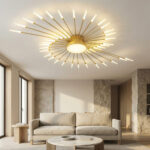
Modern LED ceiling chandelier in metal in fireworks style
See also

How Much Electricity Does a Light Bulb Use? The Sum, and What It Adds to Your Bill

Lighting for Beamed Ceilings: Where to Fix the Light and Which One to Choose

Can I Use a 60W Bulb in a 40W Lamp? What the Limit Really Protects
